

This project is carried out within the framework of the National Recovery and Resilience Plan Greece 2.0, funded by the European Union – NextGenerationEU).
Implementing Body: Information Society M.A.E.
Project Budget: €687,000.00
EU Funding: €338,780.00
Brief Project Description: Development of a software platform to assess exposure to multiple climate hazards across scenarios and horizons. It quantifies business and financial impacts, risks and opportunities. Prioritizes them and proposes monetized mitigation actions.
Grow Your Vision
Will your business
still exist in the long term?
Your next business disruption may already be on the map
Find out in 5 minutes
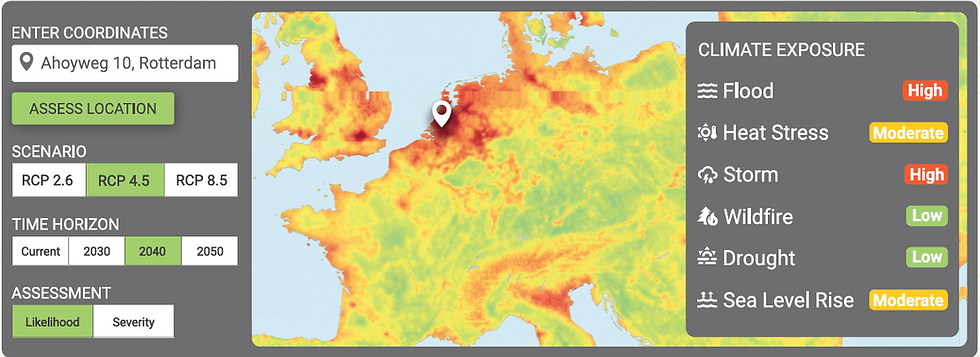
Explore Climate Change exposure,
measure its impact and
see how adaptation and mitigation actions can help you manage risks.
Test your resilience towards a sustainable future.
RiskClima does not predict Climate Change Risks
It measures their business impact and provides balanced solutions
for a sustainable future.
Is Climate Risk already on your balance sheet? The cost of inaction is measurable.
Can an asset still create value in the long term 2040, 2050?
Stop debating scenarios.
Start measuring consequences.
Your board does not need another climate report.
They'll ask one question: "So what?"

To whom it is addressed
and why now!
Everyone who owns, insures, or finances assets in Europe,
now needs measurable business impact from climate change events.
Banks
Since January 2026, European banking rules require banks to measure and manage climate risk across their loan portfolios. From 2027, climate scenario analysis becomes part of the regulatory framework. Banks increasingly need climate-risk data from their business customers and underlying assets.
Insurers
From January 2027, European insurance rules require insurers with material climate-risk exposure to conduct climate scenario analysis. In Italy, most companies must insure key business assets against natural catastrophes, with premiums reflecting each asset’s location and vulnerability and updated periodically.
Companies*
European sustainability rules require the largest firms, from almost all sectors of the economy, to quantify their financial exposure to material climate risks. The next major reporting wave starts with financial year 2027 — and 2027 budgets are being set right now.
*manufacturers, retailers, utilities, transport & logistics, technology, telecoms, agriculture & forestry etc.
Real Estate
Investors & Lenders
Every major purchase, refinancing and valuation now raises the climate question — and demands a current, defensible answer at asset level.
Investors and lenders increasingly need to understand not only whether an asset is exposed, but how material that exposure is, how it may evolve over time, and what it could mean for value, insurability, financing terms and long-term resilience.
Climate risk is becoming part of the investment case — not a separate sustainability exercise.
CROs
Climate risk has moved from sustainability reporting into the CRO’s risk agenda.
Boards, regulators, lenders and investors increasingly expect a clear view of exposure, financial impact and future vulnerability.
For CROs, the question is no longer “Are we exposed?” but “How much does it matter, where, and what should we do about it?”
CFOs
Climate risk is finding its way onto the balance sheet.
CFOs are increasingly expected to understand what climate exposure could mean for asset values, costs, financing and future performance, supporting both financial and non-financial disclosures.
They also need to evaluate a business case for adaptation and mitigation investments, balancing upfront costs against avoided losses, resilience and long-term value.
The question is no longer simply “What is the risk?” but “What could it cost us — and what is worth investing in now?”

What we measure
Every way the climate may hurt an asset.
We analyze fifteen hazards at the asset level, evaluating their likelihood and severity through 2050. By looking at both optimistic and pessimistic climate scenarios, we convert these risks into expected financial exposure.

Coastal Floods
sea level and storm surge

Precipitation
extreme rainfall

Waves
wave action at the coast
Heat & Draught

Heatwaves
extreme heat events

Heat Stress
chronic heat load

Draught
water scarcity

Wildfire
fire weather
Storms & Cold

Storms
severe thunderstorms

Hurricanes
cyclonic storms

Wind
extreme wind

Frost
freeze events
Slow Shifts

Precipitation pattern
long term rainfall change

Temperature pattern
long term warming

Wind pattern
long term wind change
Water

Floods
river and surface water

Climate risk has a price; know yours
RiskClima calculates, in monetary terms, what climate change can cost every asset a company owns, insures, or finances, and shows what to do about it.
1
Add your assets
Provide an address, a few building details and basic
financial figures.
Once: for one building
or a whole portfolio.
2
See your risk monetized
Fifteen climate hazards: from floods, coastal flooding, and hurricanes to wildfire, drought, heat stress, and shifting rain, wind, and temperature.
Patterns, from today to 2050, under optimistic and pessimistic climate scenarios.
Not vague scores: expected
loss in monetary terms, per asset, per year, with its uncertainty range stated.
3
Reduce it
A guided assessment captures what
already protects each asset; a prioritized adaptation and
mitigation plan shows what to fix first and how much risk it removes.
Progress you can show your bank, your
insurer, your stakeholders and your auditors.

Getting Started
RiskClima is a fully Software-as-a-Service (SaaS) platform, providing users complete control over its functionality from start to finish.
Simply select the plan that best suits your needs and complete your subscription. Once your account is activated, you receive secure access to the platform and can start using RiskClima immediately.
For more specific requirements, our support team is also available to provide assistance and develop tailor-made solutions.


